← Back to all projects

Buddy
Take full ownership of your finances without third-party bank aggregators. Track accounts, versioned budgets, and recurring bills in a fast, self-hostable app.
Overview
Buddy is a multi-user personal finance and transaction tracking web application built for speed, clarity, and data ownership. Designed to work equally well in a cloud deployment or self-hosted on a private server, it brings together multi-account tracking, hierarchical categories, rule-based payee categorization, recurring transaction schedules, versioned budgets, and CSV bank imports—without relying on third-party financial aggregators or external authentication services.
Key Features
Accounts & Financial Overview
- Broad Account Support: Tracks checking, savings, credit, cash, investment, loan, and custom accounts organized into drag-and-drop reorderable account groups with custom icons.
- Credit Limits & Net Worth Control: Credit accounts can toggle between showing their actual ledger balance or available credit capacity, while individual accounts can be excluded from net worth totals or archived without breaking historical records.
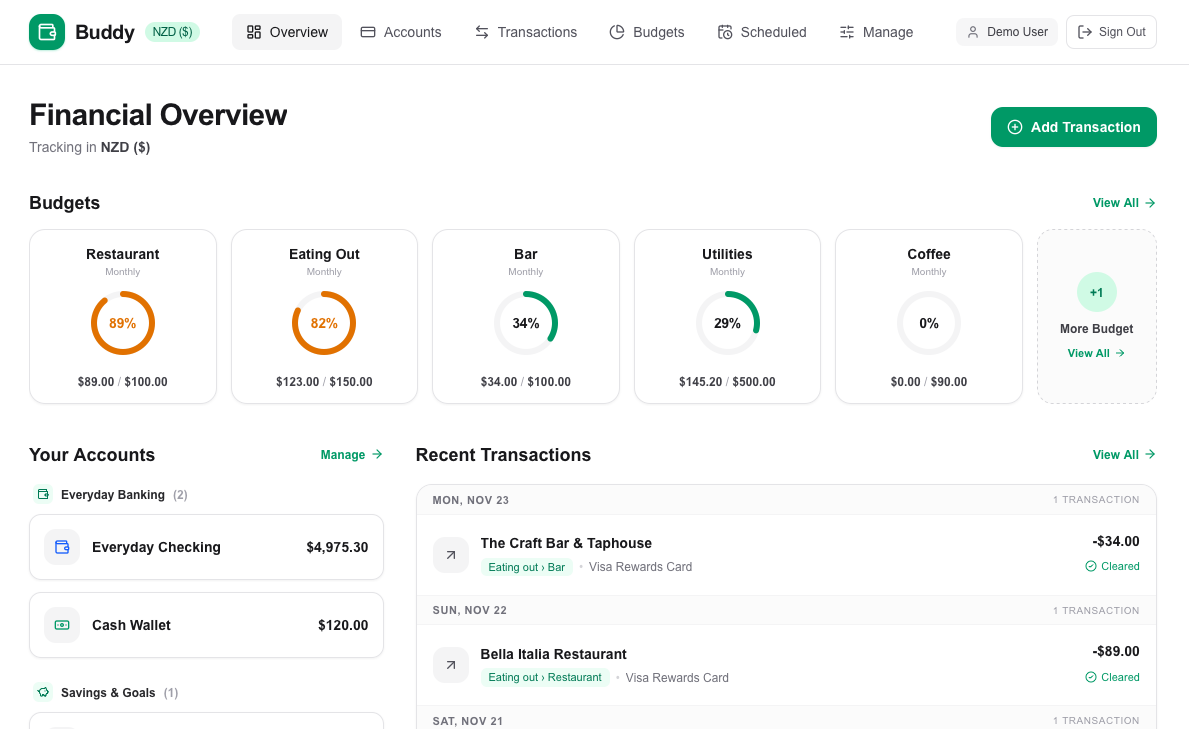
- Actionable Dashboard: Surfaces grouped account balances, a carousel of due and overdue scheduled transactions, priority budget status cards, recent activity, and global quick-record actions.
Versioned Budgets & Pacing
- Flexible Cycles & Grouping: Supports weekly, monthly, and yearly budgets organized into groups, with the option to pin key budgets to the overview dashboard and target multiple categories (including entire descendant category trees).
- Dual-Ring Progress Tracking: Custom concentric SVG progress rings display spending utilization (color-coded by threshold) alongside an inner ring for elapsed time in the cycle and a days-remaining readout.
- Non-Destructive Versioning: Editing a budget’s amount, frequency, or categories lets you either start a new version from the current cycle—preserving historical reporting—or cleanly replace prior versions.
- Budget Exemptions: Individual one-off, emergency, or reimbursable transactions can be flagged as exempt from budgets so they stay accurate in account balances and net worth without skewing regular spending targets.
Scheduled & Recurring Transactions
- Recurrence Engine: Handles one-off, weekly, fortnightly, monthly, quarterly, and yearly schedules for expenses, income, and inter-account transfers.
- Clamped Anchor Dates: Monthly, quarterly, and yearly schedules preserve their original anchor day so a payment set for the 31st safely clamps to February 28/29 and returns to March 31 instead of drifting.
- Low-Friction Posting: Due and overdue items appear on the dashboard carousel with 1-click posting, skipping, or pre-filled editing before saving.
Hierarchical Categories & Smart Payees
- Nested Alphabetical Categories: Supports arbitrary parent-child category depth with automatic alphabetical sorting across tree views, comboboxes, and filter pickers, plus linear-time rollup totals for spending and transaction counts.
- Payee Priorities & Categorization Rules: Payees are tiered (
Highest,Standard,Low,Archived) for fast selection and support a default category plus optional rules in two mutually exclusive modes:- Direction-based rules (
income/outgoing) for payees whose inflows and outflows belong to different categories. - Amount-based rules (
<=/>=thresholds) resolved via closest-threshold matching.
- Direction-based rules (
Transactions Ledger & CSV Imports
- Double-Entry Linked Transfers: Inter-account transfers create synchronized debit and credit entries linked by a shared
transfer_id, keeping edits, budget-exemption flags, and deletions atomic across both sides. - Fast Search & Filtering: Preloads ledger data for instant in-memory search across payees, categories, accounts, and notes, alongside multi-dimensional filters (including O(1) category subtree matching) and inline cleared-status reconciliation.
- Smart CSV Ingestion: Uses PapaParse with header and date normalization, automatic provisioning of unseen accounts/categories/payees, description-to-note merging, automatic payee rule evaluation, and a pre-import validation preview.
Architecture & Engineering Notes
- Server-First Next.js 16 App Router: Heavy database queries, category rollups, and budget calculations run in React Server Components and
'use server'Server Actions, with private routes protected via Next.js 16proxy.ts. - Self-Contained Auth & Tenant Isolation: Email/password credentials are hashed with Node’s native
crypto.scryptusing a 16-byte random salt and verified withcrypto.timingSafeEqual. Sessions store SHA-256 token digests in PostgreSQL behindhttpOnlycookies, and every domain table enforcesuser_idforeign keys with cascade deletes and server-siderequireUser()scoping. - Exact Integer-Cent Arithmetic: All transaction amounts, balances, and credit limits are stored and computed in signed integer cents (
amount_cents) to avoid floating-point rounding bugs, paired with client-synced timezone handling and configurable currency formatting (defaulting to NZD /en-NZ). - Self-Hosting Ready: Ships with Docker Compose for local PostgreSQL, automatic database provisioning via
npm run db:push, and an idempotent demo seeder (npm run db:seed) for local testing.
Tech Stack
- Framework & UI: Next.js 16 (App Router, Server Components, Server Actions, Proxy), React 19, TypeScript 5, Tailwind CSS v4, Lucide React
- Database & ORM: PostgreSQL (
postgres.js), Drizzle ORM & Drizzle Kit, Docker Compose - Auth & Ingestion: Native Node
crypto.scrypt+ database-backed sessions, PapaParse